The quick answer
Yes, you can dry clothes with a dehumidifier. It pulls moisture out of the room, so wet laundry on a rack evaporates faster and is less likely to smell musty. But it works slowly on heavy items, in cold rooms and in big open spaces, because it dries the air, not the clothes. If you want laundry dry faster and without filling the room with damp, a hanging warm-air dryer like the Qinux AirdrobeX is the more direct solution.
When there is no tumble dryer, no balcony and no sun, a lot of people look at the dehumidifier in the corner and wonder: can that thing dry my laundry? It is a fair question. Drying a load indoors releases a surprising amount of water into the air, and a dehumidifier is built to pull exactly that water back out. Here is how well it really works, how to get the most out of one, and where it falls short.
The problem: wet laundry and damp air
Every load you hang indoors has to lose its water somewhere, and that somewhere is the air in your home. In a small apartment, on a rainy week or in winter with the windows shut, that air quickly gets saturated. Once the air is already humid, clothes dry more and more slowly, and anything that stays damp for too long starts to smell stale. At the same time, the extra moisture can show up as condensation on windows and cold walls.
That is why indoor laundry so often turns into a two-day job — and why clothes that took forever to dry can come out smelling musty (we explain the cause in our guide on how to get rid of the musty smell in clothes).
Why a dehumidifier helps
Clothes dry through evaporation, and evaporation slows down when the surrounding air is already full of moisture. A dehumidifier draws room air over a cold coil (or through a drying material, in desiccant models), collects the water in its tank and sends drier air back into the room. Drier air around your laundry means water leaves the fabric faster.
So a dehumidifier does two useful jobs at once: it speeds up drying and it keeps the moisture from soaking into your walls and furniture. What it does not do is warm the clothes or push air through them. It works on the room, and the clothes benefit indirectly.
How to dry clothes with a dehumidifier: 7 steps
- Spin the load as hard as the labels allowLess water in the fabric means less water for the dehumidifier to remove. An extra spin on towels and jeans makes the biggest difference.
- Choose a small roomA bathroom, laundry nook or spare bedroom works far better than an open-plan living area, because the machine has less air to dry.
- Close the door and windowsOtherwise the dehumidifier keeps drying outside air that keeps flowing in, and your laundry barely benefits.
- Space the clothes outHang shirts on hangers and leave a gap between every item. Crowded laundry traps pockets of damp air.
- Place the rack near, not on top of, the machineKeep the air intake and outlet clear and follow the dehumidifier’s own manual for spacing.
- Add a fanA dehumidifier dries the air; a fan moves that drier air across the fabric. Together they work much better than either one alone.
- Empty the tank and turn heavy itemsA full tank stops the machine. Flip jeans and hoodies halfway through so the inside seams dry too.
What people try (and how each option compares)
Most people without a dryer end up mixing a few of these methods. Here is how they stack up for everyday laundry in an apartment:
| Method | Drying speed | Damp in the room | Good to know |
|---|---|---|---|
| Rack in still air | Slow | High | Free, but clothes can smell stale in humid weather |
| Rack + open window | Depends on the weather | Medium | Lets in cold air in winter and does little on rainy days |
| Rack + dehumidifier | Moderate | Low | Best in a small closed room; slower in cold rooms |
| Draping on radiators | Fast in spots | High | Uneven, hard on fabrics and a fire risk — avoid |
| Portable warm-air dryer | Fast | Contained in the cover | Warm air goes straight around the clothes; timer and remote |
Where a dehumidifier falls short
A dehumidifier is a good helper, but it is not really a clothes dryer. You will notice its limits in a few situations:
- Heavy fabrics — towels, jeans and hoodies hold a lot of water deep in the fibers, and drier room air only pulls it out slowly.
- Cold rooms — evaporation is slower in the cold, and many compressor dehumidifiers also work less efficiently at low temperatures.
- Big, open spaces — the machine spends its effort drying the whole home instead of your laundry.
- Space — you still need the rack set up in the middle of the room, plus the dehumidifier, plus a fan.
- Noise and babysitting — tanks fill up, and you have to keep checking whether the thick items are finally dry.
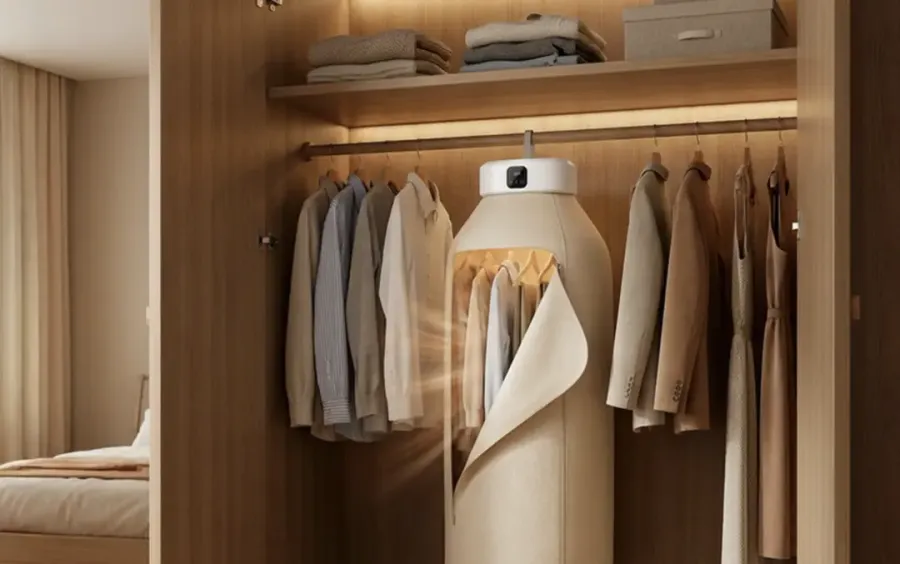
In other words, a dehumidifier dries the room so the clothes can dry themselves. A more direct approach is to put the warm, moving air right where the clothes are. That is the idea behind the Qinux AirdrobeX portable clothes dryer, which works like a compact drying closet instead of a room-sized fix.
A better setup for small homes
If you only have a rack today, you can still get most of the benefit with a simple routine: spin hard, hang on hangers, dry in the smallest room you have, keep the air moving and never leave wet clothes sitting in the washer. Our guide on how to dry clothes indoors fast has ten more tips. And if you have been weighing a full-size dryer, our portable dryer vs. tumble dryer vs. drying rack comparison lays out speed, space and power side by side.

Our recommendation: Qinux AirdrobeX
For anyone drying laundry indoors on a regular basis, the Qinux AirdrobeX is the option we recommend. It was made exactly for this problem. Instead of drying an entire room and hoping the clothes follow, it keeps everything inside its own fabric cover: you hang your shirts, blouses, knits and everyday clothes on hangers, and the unit on top circulates 360° warm air around every piece.
- Warm air where it matters — the airflow goes straight around the clothes, which is why owners say it dries much faster than hanging laundry indoors.
- Antibacterial UV light — according to the maker, it helps eliminate bacteria, dust mites and bad odors, so laundry comes out fresh instead of stale.
- Low power — rated at just 600W and plugs into a regular outlet, with no venting or installation.
- Set it and forget it — touch control panel, remote control and programmable timer, and quiet enough for a bedroom.
- Gentle on fabrics — clothes hang still instead of tumbling, and the maker says it suits cotton, wool, polyester and delicate garments.
- Compact — it stands in a corner or closet and stores away when you do not need it.
On the official site, owners rate it 4.8/5 from more than 1,200 reviews, and 94% say they would recommend it. Prices currently start at $72 per unit on the 5-pack ($109 for a single unit at the 50% launch discount), shipping is free and every order is covered by a 14-day money-back guarantee. It is sold only through the official website.
Prefer to read the details first? Our full AirdrobeX review covers setup, everyday performance and what comes in the box. Always follow the manufacturer’s instructions and the care label on each garment.
Frequently asked questions
Does a dehumidifier really dry clothes?
It helps. A dehumidifier does not heat or blow air through your clothes; it pulls moisture out of the room, so the water in wet laundry evaporates faster. Clothes on a rack next to a running dehumidifier usually dry noticeably faster than on a rack in still, humid air.
How long does it take to dry clothes with a dehumidifier?
There is no single number. It depends on the size of the room, the temperature, how much laundry you hang, how well it was spun and how powerful the dehumidifier is. Light items can be dry in a few hours, while towels, jeans and hoodies in a cold room can take most of the day.
Where should I put the dehumidifier when drying clothes?
In a small room with the door and windows closed, a short distance from the rack, with the clothes spaced out so air can move between them. Adding a fan that blows across the laundry helps a lot.
Is a dehumidifier cheaper than a tumble dryer?
Usually, yes, because a dehumidifier draws far less power than a full-size electric tumble dryer. A low-power warm-air drying closet is another option: the Qinux AirdrobeX is rated at 600W and has a timer, so it only runs as long as you set it.
Is a portable clothes dryer better than a dehumidifier for laundry?
For drying clothes specifically, a portable warm-air dryer is the more direct tool. It surrounds hanging clothes with circulating warm air inside a cover, instead of slowly drying the whole room. A dehumidifier is still useful for keeping a damp home comfortable.