The quick answer
Clean your dryer vent at least once a year, and clean the lint screen before or after every single load. That is the National Fire Protection Association’s advice, and it is the one dryer rule that is backed by real fire data: the U.S. Fire Administration found that failure to clean was the leading factor in home dryer fires. Clean the vent sooner if loads start taking longer to dry. If you would rather skip vents entirely, a ventless warm-air drying closet such as the Qinux AirdrobeX dries clothes on hangers with no duct to clean.
Dryer advice is full of round numbers: once a year, every load, 35 feet, never foil. Some of these rules are written into fire codes and safety guides; others are half-remembered tips passed between neighbors. Here is where each rule actually comes from, what the official source says today, and how to apply it in a real home, including one where there is no room, or no permission, for a vented dryer at all.
Why dryer rules matter at all
A tumble dryer works by blowing hot air through wet clothes and pushing the moist air outside through a vent. Every load sheds fibers. Most end up on the lint screen, but some slip past and settle inside the dryer and along the vent duct. Over months that layer narrows the duct, the hot air cannot leave, drying slows down and the machine runs hotter. Lint is highly combustible, which is why the U.S. Fire Administration counts an estimated 2,900 residential clothes dryer fires reported to fire departments each year in its 2008–2010 analysis. The rules below exist to keep that air path open.
Rule 1: “Clean the dryer vent once a year”
Where it comes from: the NFPA’s clothes dryer safety tips say to clean the vent pipe at least once a year, or more often if you notice it takes longer than normal for clothes to dry. Dryer manufacturers and vent-cleaning services repeat the same interval.
Does it hold up? Yes, as a minimum. “Once a year” is a floor, not a schedule that fits everyone. A family running eight loads a week, a home with pets that shed, or a vent that runs a long way with several bends will clog faster than a single person’s apartment dryer.
How to adapt it: put the vent on your calendar every 12 months, and move it forward whenever you see the warning signs: longer drying times, a hot laundry room, a burning smell or lint around the outside flap. Our guide to why a dryer gets hot but does not dry clothes walks through those symptoms in order.
Rule 2: “Clean the lint screen after every load”
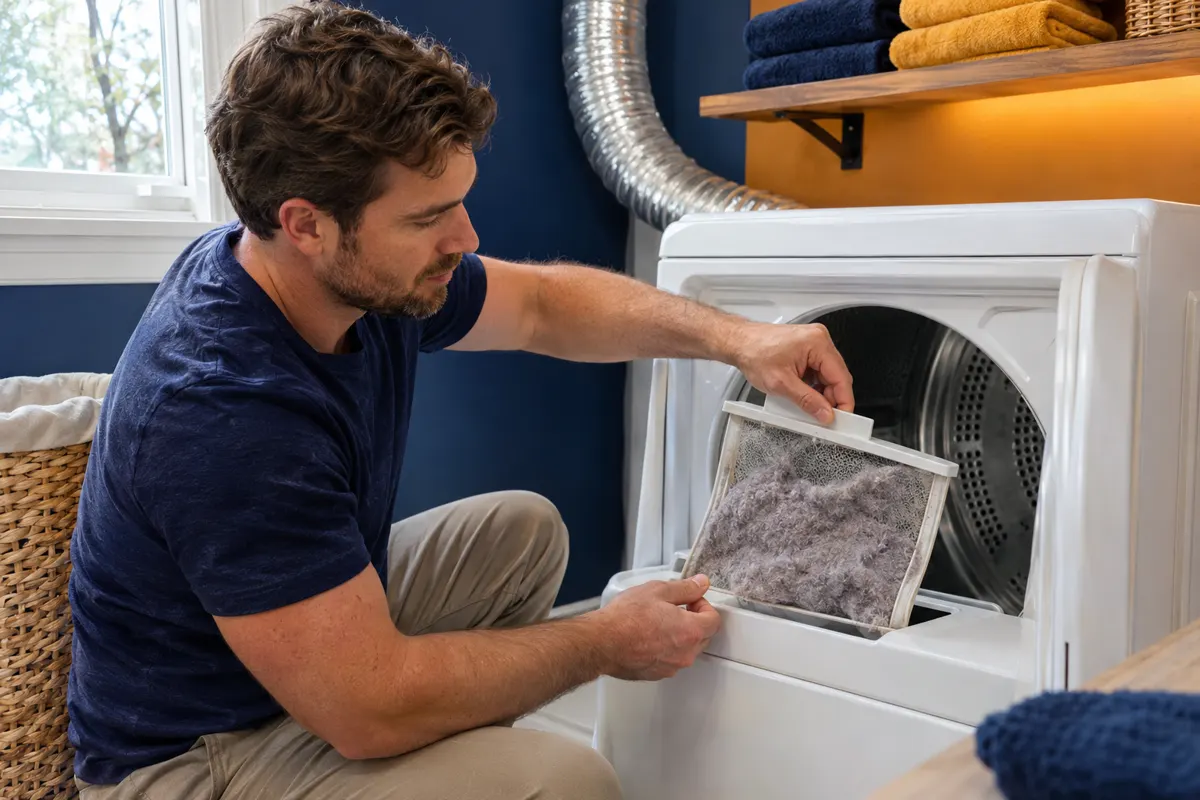
Where it comes from: NFPA and the Consumer Product Safety Commission both tell owners to clean the lint filter before or after each load. It is also printed in nearly every dryer manual and often on the screen itself.
Does it hold up? Completely. This is the cheapest fire prevention in the house and it also makes every load dry faster, because a clean screen lets air move freely. Never run the dryer without the screen in place.
How to adapt it: make it automatic: pull the screen as you load, not as you unload, so a forgotten screen never gets a second load of lint.
Rule 3: “Wash the lint screen every six months”
Where it comes from: this one is less official. Many appliance makers suggest washing the screen with warm soapy water when it looks clogged, because dryer sheets and fabric softener can leave an invisible film on the mesh. The “every six months” version circulates widely online, but we could not find a single official source for that exact number.
How to adapt it: do the water test. Hold the clean, dry screen under the tap: if water pools on top instead of running through, the mesh is coated and needs a gentle scrub with a soft brush and dish soap. Let it dry completely before putting it back.
Rule 4: “Never use a foil or plastic duct”
Where it comes from: CPSC and fire departments recommend rigid or semi-rigid metal ducts instead of white plastic or thin foil accordion hoses. Flimsy ducts sag behind the machine, get crushed when the dryer is pushed back, and their ridges catch lint.
Does it hold up? Yes. If the hose behind your dryer is white vinyl or crinkly foil, replacing it is one of the most useful small upgrades you can make. Also check the dryer manual: it lists the duct types the manufacturer approves.
Rule 5: “A dryer vent can’t be longer than 35 feet”
Where it comes from: building codes. The International Residential Code, which many U.S. states and cities adopt, limits the length of a dryer exhaust duct, starting from 35 feet and subtracting length for every elbow, unless the dryer manufacturer allows a longer run. Your local code and the installation manual are what actually apply to your home.
How to adapt it: you rarely need to measure anything, but the idea is useful: the longer and bendier the vent, the faster it clogs and the more often it needs cleaning. Apartments where the dryer sits in a closet far from an outside wall are the classic example.
The rules at a glance
| The rule people repeat | Where it comes from | Verdict | What to do |
|---|---|---|---|
| Clean the vent once a year | NFPA safety tips | True, as a minimum | Yearly, sooner if drying slows |
| Clean the lint screen every load | NFPA, CPSC, dryer manuals | True | Before or after each load |
| Wash the screen every 6 months | Appliance makers (no fixed interval) | Origin of the number unclear | Wash when the water test fails |
| No foil or plastic ducts | CPSC, fire departments | True | Rigid or semi-rigid metal duct |
| Vent max 35 feet | International Residential Code | True where adopted, minus elbows | Shorter, straighter runs clog less |
How to clean a dryer vent, step by step
- Unplug the dryerFor a gas dryer, follow the manual and be careful with the gas line; if in doubt, call a professional.
- Pull the dryer out gentlyLeave enough room to reach the duct without crushing it.
- Disconnect the ductLoosen the clamp at the back of the dryer and at the wall.
- Clear the lintUse a vent brush kit and a vacuum on the duct, the dryer outlet and the wall opening.
- Check the outside flapRemove lint, nests or debris so the flap opens freely.
- Reconnect and testRun the dryer for a few minutes and confirm strong airflow at the outside vent.
Long, high or rooftop vents are a job for a vent-cleaning service. While the dryer is out of action, our plan for drying clothes while you wait for a repair keeps the laundry moving.

What if you don’t want a vent at all?
Many renters cannot install a vented dryer, and plenty of homeowners are tired of pulling the machine out once a year. That is where ventless drying makes sense. A warm-air drying closet does not push air through a duct to the outside: your clothes hang inside a cover and warm air circulates around them. With no duct, three of the five rules above simply disappear. You still keep the room ventilated and follow the care instructions, but there is nothing to snake, brush or replace behind a machine. We explain the mechanics in how a portable clothes dryer works.
Our recommendation: Qinux AirdrobeX
If the vent is the part of laundry you dread, the Qinux AirdrobeX is the simplest way to take it out of the picture. It is a compact, ventless drying closet: hang your laundry on hangers inside its cover, set the timer and the unit on top surrounds every piece with 360° warm air. No duct, no outside flap, no installation, and it is exactly the solution we recommend for apartments, rentals and homes without a laundry hookup.
- No vent, no duct to clean — plugs into a regular outlet and works in any room.
- 360° warm-air circulation — dries both sides of shirts, sweaters and towels on hangers.
- Antibacterial UV light — according to the maker, it helps eliminate bacteria, dust mites and odors.
- 600W with timer and remote — touch panel and programmable timer that switches it off by itself.
- Gentle on fabrics — nothing tumbles, so knits and delicates keep their shape.
Owners rate it 4.8/5 from 1,289 reviews on the official site, and 94% would recommend it. One unit is $109 at the 50% launch discount, with free shipping and a 14-day money-back guarantee. It is sold only through the official website.
Want the details first? Read our full AirdrobeX review or see the packages on the AirdrobeX home page. Always follow your dryer’s manual, local codes and the care label on each garment.
Frequently asked questions
How often should you clean your dryer vent?
The National Fire Protection Association advises cleaning the dryer vent pipe at least once a year, and sooner if clothes start taking longer to dry. Large families, pet owners and homes with long or bendy vent runs often need it more often. The lint screen itself should be cleaned before or after every load.
How do I know my dryer vent needs cleaning?
Common signs are loads that take longer than usual to dry, a dryer or laundry room that feels hotter than normal, a burning smell, lint collecting around the outside vent flap, and a flap that barely opens while the dryer runs. If you notice a burning smell, stop the dryer and have it checked.
Can a dirty dryer vent cause a fire?
Yes. Lint is highly combustible, and the U.S. Fire Administration found that failure to clean was the leading factor in residential clothes dryer fires, at 34 percent of cases in its 2008 to 2010 analysis. Cleaning the lint screen and the vent is the simplest prevention.
Are foil or plastic dryer ducts safe?
Fire-safety agencies such as CPSC recommend rigid or semi-rigid metal ducts instead of plastic or thin foil accordion ducts, which can sag, crush and trap lint. If your dryer is connected with a white plastic or crinkly foil hose, it is worth replacing.
Does a portable clothes dryer need a vent?
A warm-air drying closet like the Qinux AirdrobeX does not connect to a vent duct at all. Clothes hang inside a cover and the unit circulates warm air around them, so there is no duct to clog or clean. Just follow the maker’s care instructions and keep the room ventilated.