The quick answer
No. You should not leave a tumble dryer running overnight or while you are out. Dryer manufacturers and fire-safety advice agree: a dryer combines high heat, a motor and flammable lint, and the danger of any fault multiplies when nobody is awake to notice it. The better routine is to spin clothes well, run the dryer while you are home, clean the lint filter every load, and for the clothes that still need drying at bedtime, use a low-power hanging dryer with an automatic timer, which is exactly what the Qinux AirdrobeX is.
It is 10 p.m., the laundry is finally washed, and the easiest thing in the world is to throw it in the dryer, press start and go to bed. Lots of people do. But “is it safe to leave the dryer on overnight?” is one of the most searched laundry questions for a reason: almost everyone has a nagging feeling about it. Here is what the manuals and fire-safety guidance actually say, where the real risk comes from, what to do with wet clothes at bedtime, and how to set up your home so the question stops coming up.
What the manuals and safety advice say
Read the safety section of almost any tumble dryer manual and you will find the same two lines: do not leave the appliance running while you are out or asleep, and clean the lint filter after every cycle. Fire-safety organizations repeat the same advice for all high-heat appliances, dryers included. In the US, clothes dryers are involved in thousands of home fires every year, and failure to clean the dryer is consistently named as the leading contributing factor.
The reasoning is not that a well-maintained dryer is likely to fail on any given night. It is that when something fails, the outcome depends on whether someone is awake to smell it, hear it or see it. A small overheating problem noticed in two minutes is a replaced part. The same problem at 3 a.m. is a very different story.
Why a running dryer is a risk in the first place
- Lint. Fluff from towels, cotton and fleece collects in the filter, around the drum and inside the exhaust duct. It restricts airflow, which makes the dryer run hotter and longer, and lint itself ignites easily. This is the number one cause of dryer fires.
- Heat plus friction. A tumble dryer heats air to well over 100°F while a motor spins a heavy drum for an hour or more. Bearings, belts and heating elements wear out.
- Thermostat or sensor faults. If the component that is supposed to stop the heating element fails, the dryer can keep heating with no one to stop it.
- Blocked or crushed vents. A vent hose kinked behind the machine or a lint-clogged outside flap traps hot, moist air inside.
- What is in the drum. Items that touched oil, grease, gasoline or cooking fat can ignite at dryer temperatures even after washing. Rubber-backed mats, foam and some plastics also react badly to heat.
- The warm pile afterwards. Even after the cycle ends, a dense pile of hot laundry left in the drum keeps its heat. Manuals tell you to remove and spread out clothes at the end of the cycle for exactly this reason.
Notice that none of these risks are about running a dryer at night specifically. The night is simply when nobody is watching.

The safe dryer routine, step by step
- Spin on the highest safe setting firstA good spin removes more water in ten minutes than a dryer does in twenty. Shorter cycles mean less heat for less time.
- Clean the lint filter every single loadNot every week. Every load. It takes five seconds and removes the main fire risk.
- Check the vent hose and outside flap monthlyThe hose should be short, straight and uncrushed; the flap should open freely when the dryer runs. Have the duct cleaned at least once a year.
- Keep the area around the dryer clearNo laundry baskets, cardboard or spare detergent bottles behind or on top of the machine.
- Run it while you are home and awakeStart the cycle when you still have a couple of hours up. If that is not possible tonight, see the next section.
- Empty the drum when the cycle endsTake the clothes out, shake them and hang or fold them. Do not leave a warm compressed pile in the drum.
- Never dry items that touched oil, fuel or cooking greaseAir-dry those, after washing them with extra detergent.
What to do with wet laundry at bedtime
The realistic problem is not the rule, it is the pile of wet clothes at 10 p.m. You need them tomorrow and you are not going to sit up for a 90-minute cycle. Here are the options, honestly compared.
| Option | What happens overnight | Verdict |
|---|---|---|
| Run the tumble dryer and sleep | Clothes are dry by morning, but you are running a high-heat appliance unattended, against the manual. | Not recommended |
| Leave clothes in the washer | Fine for one night, but the closed, damp drum breeds the musty smell; often means a rewash. | Only as a last resort |
| Hang on a rack or hangers | Safe and free. In a warm, airy room light items dry by morning; jeans, towels and hoodies will still be damp. | Good for light loads |
| Set the dryer’s delay-start for the morning | Clothes sit wet for hours, then dry while you get ready. Works if your machine has the feature and you are home in the morning. | Workable |
| Hanging warm-air dryer with timer, run in the evening | Clothes hang on hangers in a closed cover with 600W warm air; the timer shuts it off. Run it after dinner while you are up, and the load is finished before bed. | Our pick |
The last option is the one that changed our own routine. Instead of a late-night 2,000–5,000W drum cycle, a compact warm-air dryer like the Qinux AirdrobeX finishes a hanging load during the evening at a fraction of the power, with no lint trap to forget and no drum to tumble. The same “run it while you are home” rule still applies, but it becomes easy to follow because the whole process happens before you go to bed, not after. If you want the numbers, our guide on how much electricity a clothes dryer uses compares a tumble dryer with a 600W unit.
What NOT to do, whatever dryer you have
- Do not use a timer plug to make a dryer start while you sleep. It solves the convenience problem and creates the safety problem.
- Do not override the door switch or thermostat to keep a cycle going.
- Do not stack baskets, hampers or clothes on top of a running dryer.
- Do not ignore a burning smell or a dryer that is suddenly much hotter to the touch. Stop it, unplug it and have it looked at.
- Do not restart cycle after cycle because clothes come out damp. Fix the cause: a weak spin, an overloaded drum, or a blocked vent.
Our recommendation: Qinux AirdrobeX
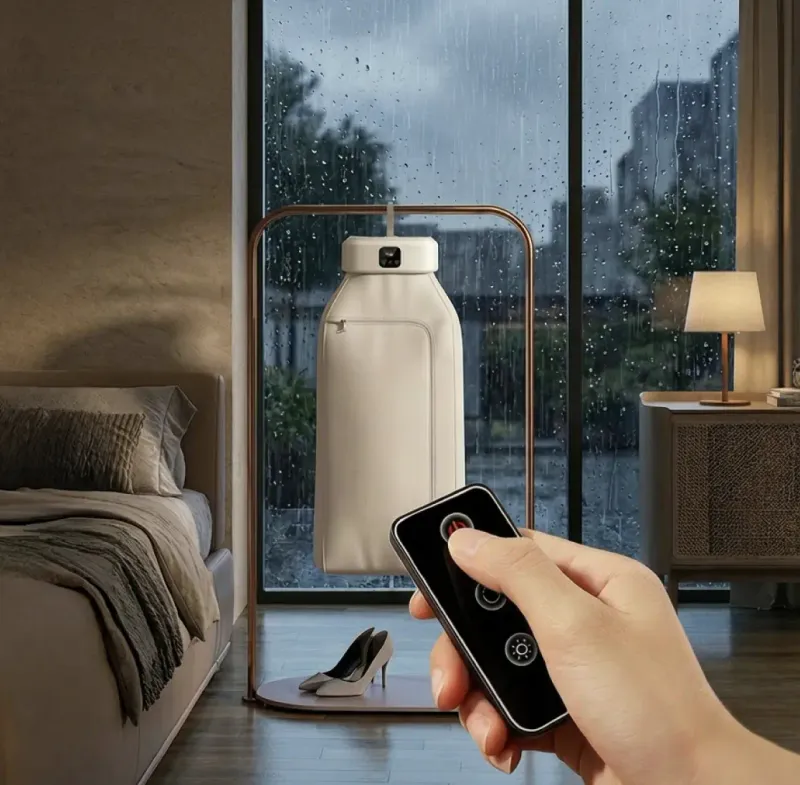
If late-evening laundry is your normal life, the Qinux AirdrobeX is the dryer we recommend. It is built for exactly this situation: clothes hang on hangers inside a closed cover, 360° warm air dries them while you have dinner or watch a show, and the programmable timer switches the unit off on its own, so the load is finished before bedtime and nothing is left running through the night. It is the most practical way to end the “dryer on overnight” habit without going back to damp clothes in the morning.
- 600W from a regular outlet — a fraction of a tumble dryer’s draw, with no vent, no duct and no installation.
- Programmable timer, touch panel and remote — set the time for the load and it shuts off by itself.
- No tumbling drum, no lint filter to forget — clothes hang still while warm air circulates around them.
- 360° warm-air circulation — dries both sides of every garment at once, including wool, cotton, polyester and delicates.
- Antibacterial UV light — according to the maker, helps eliminate bacteria, dust mites and odors while clothes dry.
- Compact — stands in a corner of the bedroom or hallway while it works and folds away afterwards.
Owners rate it 4.8/5 from 1,289 reviews on the official site, and 94% would recommend it. One unit is $109 at the 50% launch discount, and multi-packs bring it down to $72 per unit, with free shipping and a 14-day money-back guarantee. It is sold only through the official website.
Want the details first? Read our full AirdrobeX review, see the packages on the AirdrobeX home page, or read what to do when your dryer broke and you still need dry clothes. Always follow the manufacturer’s manual for any heated appliance.
Frequently asked questions
Is it OK to leave a tumble dryer running overnight?
Dryer manufacturers and fire-safety organizations generally advise against running a tumble dryer while you are asleep or away from home. Dryers combine high heat, a motor, friction and flammable lint, and a fault is far more dangerous when nobody is awake to notice it. Run it while you are home and awake, and clean the lint filter after every load.
Why do dryers catch fire?
The most common cause is lint. It builds up in the filter, the drum cavity and the exhaust duct, blocks airflow, makes the machine run hotter, and is itself very flammable. Other causes are blocked or crushed vents, failed thermostats or heating elements, worn wiring and items left in pockets. Regular cleaning removes most of the risk.
Can I leave wet clothes in the washer overnight instead?
For one night, usually yes, but clothes left wet in a closed drum start to smell musty and may need rewashing. If you cannot dry them that evening, hang them on hangers or a rack so air can reach them, or use a timer-controlled hanging dryer that switches itself off.
Is a portable clothes dryer safer than a tumble dryer at night?
A hanging warm-air dryer like the AirdrobeX runs at 600W, has no tumbling drum and no lint trap, and shuts off on its own timer, which removes several of the classic dryer risks. It is still a heated appliance: we recommend running it while you are home and awake, with space around it, exactly as the manual says.
Does a dryer use less electricity at night?
Only if your utility has a time-of-use plan with cheaper off-peak rates. Even then, the saving on one load is small, and it does not change the safety advice. A 600W dryer running in the evening costs cents per cycle anyway; see our guide to how much electricity a dryer uses.
How long can a dryer run safely in one go?
Follow the cycle lengths in your manual; most tumble dryers are designed for cycles of up to a couple of hours. Running back-to-back loads for many hours, or restarting a cycle because clothes are still damp, makes the machine run hot for longer. Spin clothes well first so each cycle stays short.