The quick answer
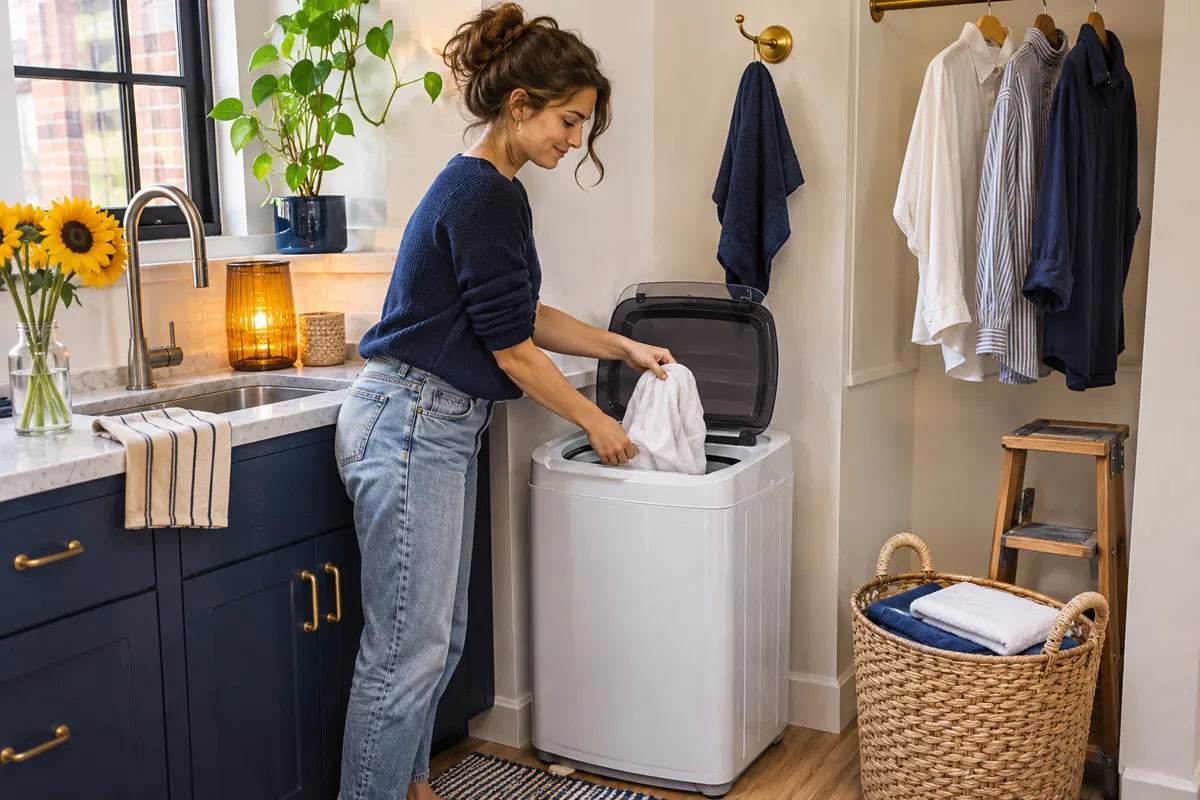
To set up laundry in an apartment with no hookups you need two stations: a portable washer that fills from the faucet and drains into the sink or tub, and a drying option that needs no vent. Add a faucet adapter, a drain plan, a mat, hangers and a few care items, and you are done. For the drying half we recommend a ventless warm-air drying closet such as the Qinux AirdrobeX, which plugs into a regular outlet and folds away after use.
“Portable washer” is one of the fastest-rising laundry searches in the U.S. right now, and it is easy to see why: rents are high, many older buildings have no laundry hookups, and the laundromat eats a whole evening every week. The washer is only half the job, though. Wet clothes have to dry somewhere, and that is where most apartment setups fall apart. Below is the full shopping list, organized like aisles in a store, so you buy what you need once and skip what you do not.
Before you buy: three checks that save money
- Read your lease. Some buildings restrict appliances that use water. A quick email to the landlord avoids surprises.
- Find your faucet and drain. Most portable washers connect to a kitchen faucet with an adapter and drain into a sink or tub. Check whether your faucet has a removable aerator, because that is where the adapter usually screws on.
- Find the outlet. You want a grounded wall outlet near the water, away from splashing. Many manufacturers advise plugging appliances directly into the wall rather than into an extension cord; follow the manual of each machine.
The no-hookup laundry shopping list
| Station | What to buy | Why it matters |
|---|---|---|
| Washing | Compact portable washer sized for your household | Small loads, done at home whenever you want |
| Water in | Faucet adapter / quick-connect (often included) | Fills the washer from the kitchen or bathroom tap |
| Water out | Drain hose long enough to reach the sink or tub, plus a hose clip | Keeps the hose from jumping out mid-cycle |
| Floor | Waterproof mat or drip tray | Protects rental floors from drips and vibration |
| Drying | Ventless drying option: rack and/or a warm-air drying closet | No vent, no installation, no damp clothes all over the apartment |
| Hanging | Slim non-slip hangers (one per shirt) | Hanging dries both sides at once and cuts wrinkles |
| Care | Low-sudsing detergent, mesh laundry bags, lint roller | Small machines and delicates need gentle, low-foam washing |
| Storage | Collapsible basket or hamper with handles | Moves loads from the washer to the dryer in one trip |
Aisle 1: the washing station
The portable washer
Pick capacity by how you live, not by the biggest number on the box. A single person or couple usually does fine with a compact model and more frequent small loads; a family may prefer a larger tub or a twin-tub. Look for a spin cycle you can trust, because the better the spin, the less water your drying station has to deal with. That single detail decides how fast clothes dry later.
Hoses, adapter and clip
Most portable washers ship with a fill hose, a drain hose and a faucet adapter. Measure the distance from where the washer will stand to your sink or tub before you buy any extension hose. A simple clip that holds the drain hose on the edge of the sink is cheap and prevents the classic “hose jumped out” flood.
Mat and placement
A rubber mat or drip tray protects the floor and dampens vibration. Keep the washer on a level surface, close to the drain, and never block walkways with hoses.
Aisle 2: the drying station (where most setups fail)
Here is the honest part: a portable washer solves washing, but a closet full of soaking-wet clothes on chairs and doors is not a laundry system. Drying is the bottleneck in every apartment without hookups, for three reasons:
- Compact vented dryers still need a vent path, which many rentals do not have.
- Racks alone are slow in cold, humid months, and a full load spread around the living room raises the humidity in a small space.
- Clothes that dry slowly can smell musty (here is how to get rid of that smell).
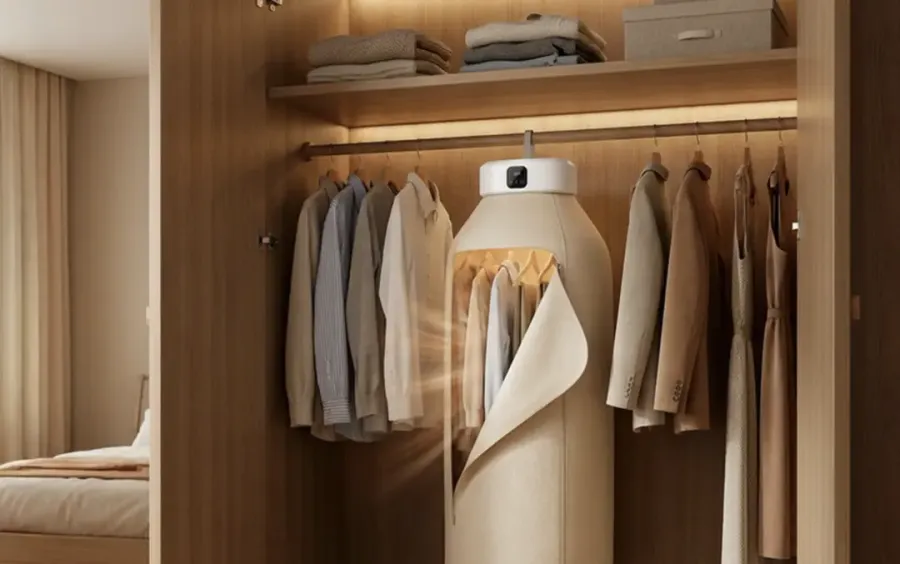
That is why we suggest a two-part drying station: a small rack for socks and light items, and a ventless warm-air drying closet for shirts, pants and towels. The Qinux AirdrobeX is built exactly for this: clothes hang inside its cover while the unit on top circulates warm air around every piece, from a regular outlet, with no vent hose.
Aisle 3: hanging and fabric care
- Slim non-slip hangers — buy enough for one full load of shirts. Hanging straight from the washer is the fastest way to fewer wrinkles.
- Mesh laundry bags — for socks, bras and small items, so nothing tangles in a compact drum.
- Low-sudsing detergent — small tubs foam over easily; follow the dose on the label for small loads.
- A lint roller — for a quick finish on dark clothes after drying.
- A care-label cheat sheet — our guide to laundry drying symbols tells you what can take warm air and what should dry flat.
Aisle 4: safety and small extras
- A grounded wall outlet for each appliance, and a habit of unplugging when you are done.
- A towel by the sink for the occasional splash when you connect and disconnect hoses.
- A phone alarm for the end of the wash, so clothes go to the dryer right away instead of sitting wet in the drum.
What you can skip
You do not need dryer sheets for hanging drying, special “portable washer detergents” with premium prices, or a second rack if you already have a drying closet. You also do not need to buy everything on day one: start with the washer, the adapter, a mat and your drying station, then add hangers and bags as you go.
A simple weekly routine with this setup
- Sort into two or three small loadsDarks, lights and towels. Small loads wash and dry faster.
- Wash with the highest spin the fabric allowsLess water in the clothes means shorter drying.
- Hang immediatelyShirts and pants on hangers inside the drying closet, socks and small items on the rack.
- Set the timer and walk awayCheck the first loads to learn your times, then rely on the timer. Our first-week guide walks you through it.
Our recommendation: Qinux AirdrobeX
A portable washer handles the washing; the Qinux AirdrobeX is the drying half we recommend for any apartment without hookups. It is a compact drying closet: your clothes hang inside the cover while the unit on top blows 360° warm air around each piece. No vent, no installation, no landlord approval for ducts, and it folds away when the laundry is done.
- Plugs into a regular outlet — 600W, no vent hose and nothing to install.
- 360° warm-air circulation — dries both sides of every hanging garment, even in a cold, rainy week.
- Antibacterial UV light — according to the maker, it helps eliminate bacteria, dust mites and odors while clothes dry.
- Touch panel, remote and programmable timer — set it after the wash and it switches off on its own.
- Gentle on fabrics — nothing tumbles, so cotton, wool, polyester and delicates dry without friction.
Owners rate it 4.8/5 from 1,289 reviews on the official site, and 94% would recommend it. One unit is $109 at the 50% launch discount, two are $190 ($95 each) and larger packs go down to $72 per unit, with free shipping and a 14-day money-back guarantee. It is sold only through the official website.
Want the details first? Read our full AirdrobeX review or see the packages on the AirdrobeX home page. Always follow each manufacturer’s manual and your building’s rules.
Frequently asked questions
Can you have a washer and dryer in an apartment without hookups?
Yes, as long as you choose machines built for it. Portable washers usually fill from a kitchen or bathroom faucet with an adapter and drain into the sink or tub, and a ventless drying option such as a hanging warm-air drying closet plugs into a regular outlet. Always check your lease first, because some buildings limit appliances.
What do I need for a portable washer?
The washer itself, the faucet adapter that fits your sink (or a bucket fill if the model allows it), a drain hose long enough to reach the sink or tub, a small mat or tray under the machine, low-sudsing detergent and a spot near a grounded wall outlet. Most of the hoses and adapters come in the box, so read the manual before you buy extras.
What is the best dryer for an apartment with no vent?
One that does not need a vent at all. Compact vented dryers still need an exhaust path, so many renters use a ventless option: a drying rack for light items, or a portable warm-air drying closet like the Qinux AirdrobeX, which dries hanging clothes with 360° warm air from a regular outlet.
Do portable washers use a lot of electricity?
Washers use most of their energy heating water, and many portable models fill from the faucet, so the power draw of the machine itself is usually modest. Check the wattage label on the model you choose and your electricity rate to estimate your own cost per load.
Is a portable washer and dryer worth it versus the laundromat?
If you do several loads a week, a home setup saves the trips, the waiting and the quarters, and you can wash small loads whenever you want. The laundromat still makes sense for bulky items like comforters.