The quick answer
Dry most everyday loads on medium, delicates, knits and synthetics on low, and only sturdy cotton such as towels, sheets and jeans on high. In a typical U.S. dryer that means roughly 120°F on low, 130°F on medium and 140–145°F on high. Every source we compared agrees on two more rules: read the care label first, and do not over-dry. Where they differ is on the exact numbers, which change from brand to brand and test to test.
“What temp to dry clothes” is one of the laundry questions climbing fastest in Google Trends this fall, and it is easy to see why: dryers default to high, care labels speak in dots, and every brand calls its settings something different. Instead of adding one more opinion, we put four kinds of sources side by side: the international care-label standard, a major dryer maker’s settings guide, an independent lab test and ENERGY STAR. Below you will see where they line up (the part you can follow with confidence) and where they split, and why.
The four sources, side by side
| Source | What it says about drying temperature | Type / link |
|---|---|---|
| GINETEX care symbols (international care-label standard) | One dot = tumble dry at a lower temperature, up to 60°C (about 140°F). Two dots = normal drying, up to 80°C (about 176°F). The number of dots shows how hot the process may be. | Care-label standard, ginetex.net |
| Samsung dryer settings guide | High (about 140–145°F) for sturdy cottons; medium (about 130–133°F) for permanent press, synthetics and lightweight cottons; medium low for synthetic or washable knits; low (about 120–122°F) for heat-sensitive items; extra low (about 100–110°F). | Dryer maker, samsung.com |
| Reviewed lab tests | Measured peak temperatures from 106°F to 188°F across dryers; advises not going over about 150°F even on high, and removing clothes while slightly damp. | Independent testing, reviewed.com |
| ENERGY STAR (U.S. EPA) | Certified dryers generally use lower temperatures than standard models and stop automatically when clothes are dry, which also prevents wear from over-drying. | Government program, energystar.gov |
We only list what each source actually states on the pages linked above, checked in November 2026. Numbers are rounded, and your own dryer’s manual is the final word for that machine.
Where all the sources agree
Put the four next to each other and five rules come out the same every time. These are the parts you can follow without worrying about which brand or test you trust.
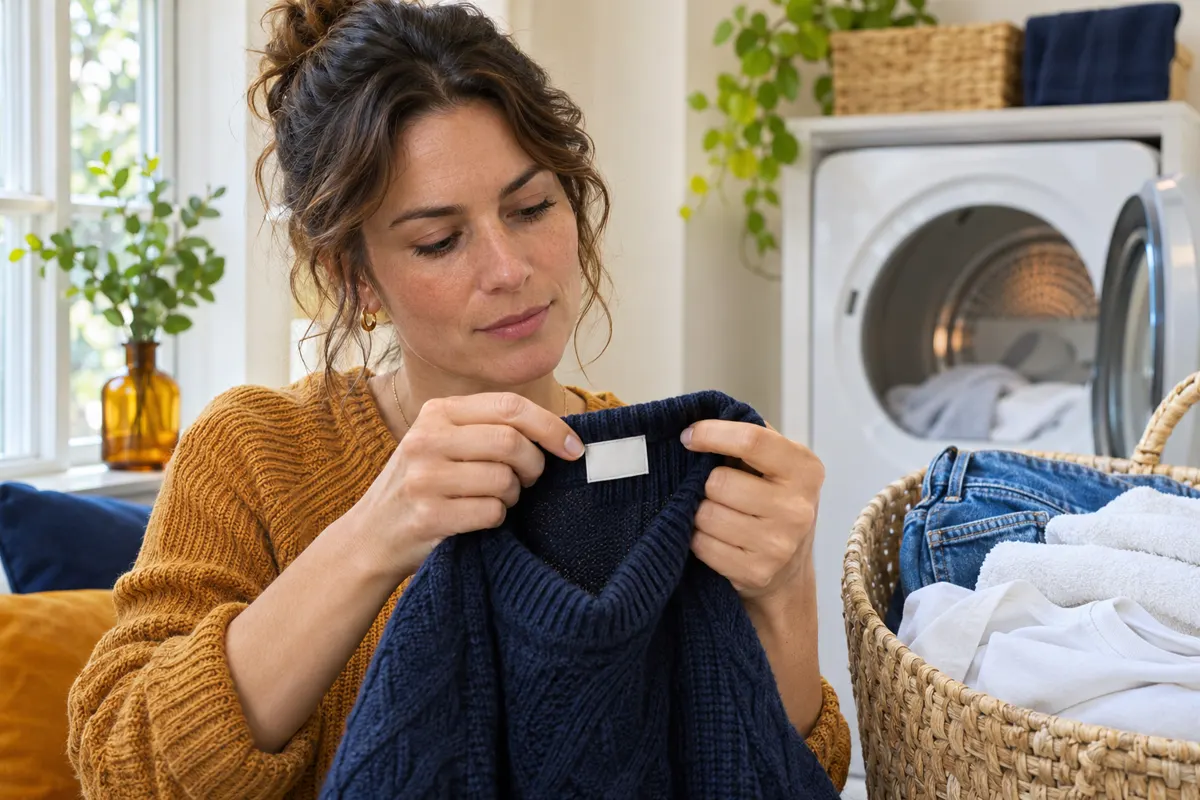
- The care label comes first.The standard behind the dots exists so the garment maker can tell you the safe maximum. In the U.S., the FTC’s Care Labeling Rule requires most clothing to carry care instructions, so the answer is usually sewn into the collar or side seam. If you are unsure what a symbol means, our guide to laundry drying symbols explained decodes them.
- Lower heat for delicate, stretchy and synthetic fabrics.Every source puts knits, lingerie, activewear, spandex and lightweight synthetics at the bottom of the dial (one dot, “low” or “delicate”).
- High heat only for sturdy cotton.Towels, sheets, jeans and work clothes are the items the maker and the label standard allow at the top setting.
- Over-drying is the real enemy.The lab test and ENERGY STAR both stress it: once clothes are dry, extra minutes of heat only add shrinkage, static and worn fibers. Sensor drying or pulling clothes while very slightly damp is the fix. More on that in how to keep clothes from shrinking in the dryer.
- Lower heat is the safer default when unsure.A load dried too cool just needs more time; a load dried too hot can be ruined. That asymmetry is why every guide leans low.
Quick temperature chart by fabric
| What you are drying | Setting most sources agree on | Typical temperature |
|---|---|---|
| Towels, cotton sheets, jeans, work clothes | High (or normal on the label) | about 140–145°F |
| Everyday cotton and cotton-blend tees, casual shirts | Medium / permanent press | about 130°F |
| Synthetics, polyester, rayon, wrinkle-prone shirts | Medium-low / permanent press | medium low to medium (about 120–133°F) |
| Knits, activewear, spandex, lingerie, sheer fabrics | Low / delicate | about 120°F (or extra low) |
| Wool sweaters, anything marked “dry flat” | No tumble heat: lay flat or hang as labeled | room temperature |
Need a decision for each item in the basket? Our if-then guide for every item in your laundry basket goes piece by piece.
Where they differ, and why
The disagreements are real, but they are mostly about numbers and goals, not about the basic rules above.
1. The exact degrees
The care-label standard gives a maximum (60°C or 80°C), while Samsung describes what its own settings typically reach (about 100°F on extra low up to 145°F on high). Those are different measurements, so they do not contradict each other. The lab test adds a third angle: real machines vary a lot, with peaks anywhere from 106°F to 188°F. “Low” on one brand is not “low” on another, which is why the setting name matters less than how your clothes come out.
2. Speed versus fabric life
A maker’s cycle guide has to balance drying time with fabric care, so high heat is presented as normal for heavy loads. The lab test and ENERGY STAR put more weight on fabric wear and energy, so they push toward lower heat and automatic shut-off. Both views are reasonable; they simply optimize for different things.
3. Germs and sanitizing
Some appliance guidance recommends high or sanitize cycles for bedding and towels, while the fabric-care side warns that the same heat shortens a garment’s life. The practical middle ground: use high heat for the sturdy items that need it, and keep delicates and everyday clothes lower.
What the consensus means for drying at home
If you strip away brand names, the consensus is surprisingly simple: gentle, even warmth, no more heat than the label allows, and stop as soon as clothes are dry. Tumbling at high heat is the hardest treatment a garment gets in its life, which is why so many people hang their best clothes instead. The catch with hanging is time: in a cool, still room, a sweater or pair of jeans can take most of a day (see how long it takes to dry clothes in each place).
That is the gap a hanging warm-air dryer fills. The Qinux AirdrobeX lets clothes hang still on hangers while warm air circulates around them, so you get the gentleness of air-drying without waiting until tomorrow. Its maker does not publish an exact air temperature, and we will not guess one, so keep following each garment’s care label.

Our recommendation: Qinux AirdrobeX
If the sources agree on anything, it is that your clothes last longer with gentle warmth and no over-drying. The Qinux AirdrobeX was made for exactly that kind of drying. Instead of tossing a sweater or a favorite shirt into a hot, spinning drum, you hang it inside the AirdrobeX cover, set the timer, and 360° warm air moves around every piece while it stays on its hanger. It is the most practical way we know to follow the “lower heat, no tumbling” consensus and still have clothes dry by the evening.
- Gentle by design — clothes hang still, so there is no tumbling, friction or crushed knits.
- Warm air all around — reaches both sides of each garment, cuffs and seams included.
- Timer and remote — set the cycle and it switches itself off, which helps you avoid over-drying.
- UV light — according to the maker, it helps eliminate bacteria, dust mites and odors while clothes dry.
- 600W from a regular outlet — no vent, no hookup, folds away when you are done.
One unit is $109 at the 50% launch discount (two units $190, three $240), with free shipping, a 4.8/5 rating from 1,289 buyers and a 14-day money-back guarantee. It is sold only through the official website. Read our full Qinux AirdrobeX review or compare the packages on the home page.
Always follow the care label on each garment and the manufacturer’s instructions for your dryer.
Frequently asked questions
What temperature should I dry my clothes at?
For most everyday loads, medium or permanent press is the safe middle (about 130°F in a typical U.S. dryer). Use low (about 120°F) for delicates, knits, activewear and anything stretchy, and save high (about 140–145°F) for sturdy cotton towels, sheets and jeans. Always check the care label first.
Is it better to dry clothes on low or high heat?
Low heat is gentler: it takes longer, but it reduces shrinking, fading and fiber wear, and it is less likely to over-dry. High heat is faster and fine for heavy cottons. When in doubt, choose the lower setting and stop the cycle while clothes are still very slightly damp.
What do the dots on a dryer symbol mean?
On international care labels, one dot means tumble dry at a lower temperature (up to 60°C, about 140°F) and two dots mean normal temperature (up to 80°C, about 176°F). U.S. labels use one, two and three dots for low, medium and high; a filled black circle means no heat.
Does high heat in the dryer kill germs?
Heat helps, and some dryer makers recommend a high or sanitize cycle for bedding and towels. But high heat also shrinks and wears fabrics, so most guidance limits it to sturdy items that can take it rather than using it for every load.
How hot is too hot for a clothes dryer?
Reviewed’s lab measured peak dryer temperatures from 106°F up to 188°F and advises against going over about 150°F even on the highest setting, because above that you create the conditions for fabric damage. If your dryer runs very hot, use a lower setting and clean the lint screen and vent.
What temperature does a portable clothes dryer use?
Hanging warm-air dryers circulate warm air around clothes that hang still instead of tumbling, which is gentle on fabrics. The maker of the Qinux AirdrobeX does not publish an exact air temperature, so follow the garment care label and the manual.