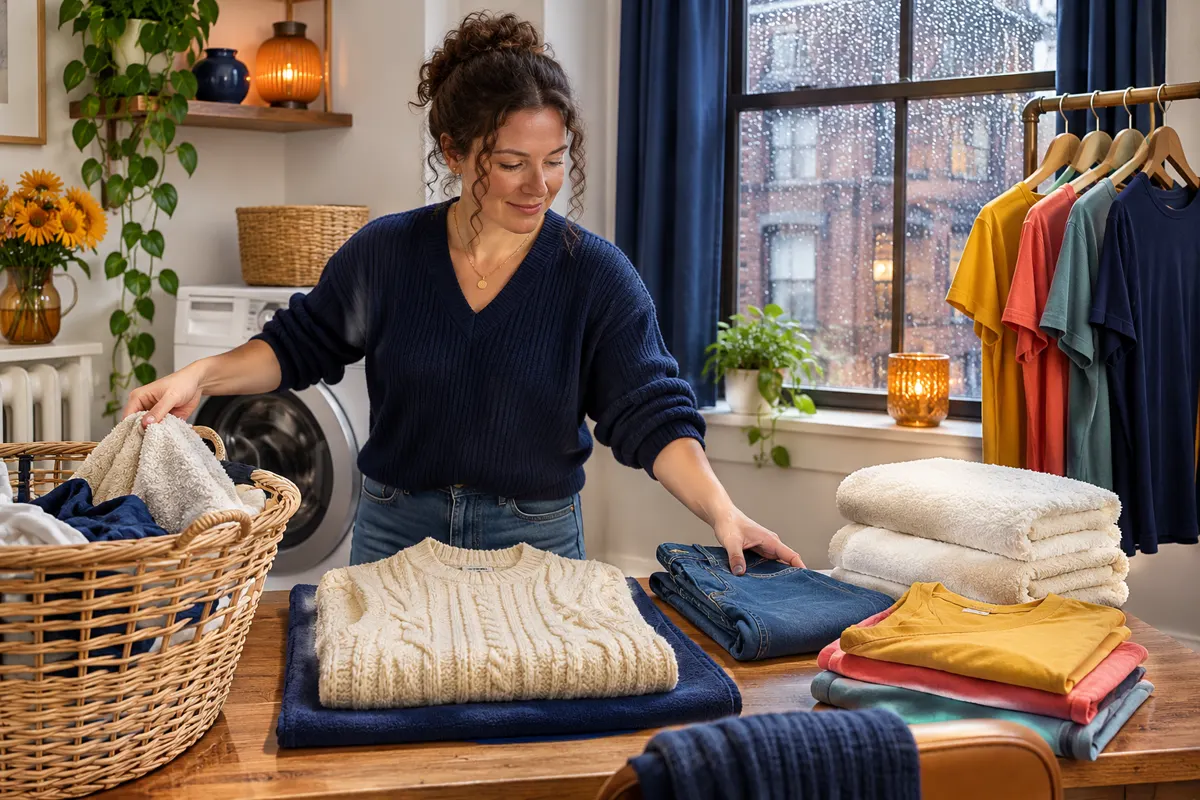
The quick answer
Start with the care label, then match the item to its method: delicates and wool hang still or lie flat, towels and jeans get their own load with time to dry fully, everyday cotton and synthetics can hang on hangers, and anything you need fast goes into moving warm air. If you do not own a tumble dryer, or you want a gentler option for most of your basket, a hanging warm-air dryer like the Qinux AirdrobeX covers almost every branch of the map below.
Every laundry day has the same moment: the washer beeps, you open the door and you stare at a tangle of sweaters, jeans, towels and gym wear, wondering what can go where. Guess wrong and a favorite sweater shrinks, the jeans stay damp until tomorrow or the towels come out stiff. This guide is a decision map. Find your situation, follow the arrow, and you will know what to do with each item in under a minute.
Step 1: read the label before anything else
The care label is the manufacturer telling you how that fabric behaves. Five symbols cover almost every decision:
- Square with a circle → tumble drying is allowed. Dots inside the circle show the heat level (one dot = low).
- Square with a crossed-out circle → do not tumble dry. Hang it or lay it flat.
- Square with a curved line at the top → line dry.
- Square with three vertical lines → drip dry (hang it soaking wet, without wringing).
- Square with one horizontal line → dry flat.
Need the full list? Our laundry drying symbols guide translates all twelve common terms into plain English.
Step 2: the if-then map, item by item
Once you know what the label allows, use the map below. Each branch ends in one clear action.
| If you are holding… | Then do this | Why |
|---|---|---|
| A wool or cashmere sweater | Lay it flat on a towel, reshape it, turn it once | Heat and tumbling felt and shrink wool; hanging a wet knit stretches it. |
| An acrylic or cotton knit | Dry flat, or hang only once it is half dry | Wet knits are heavy and stretch at the shoulders. |
| Jeans | Inside out, hang by the waistband, own load | Thick seams and pockets need the longest time; low or no heat limits fading. |
| Bath towels | Shake hard, hang open with space, own load | Towels hold the most water and slow everything around them. |
| Gym wear and leggings | Hang right after washing, no high heat | Synthetics dry fast; heat can damage stretch fibers and lock in odor. |
| Bras, lingerie, swimwear | Hang still, never tumble | Underwire, elastic and foam cups lose their shape in a drum. |
| Work shirts and blouses | Hang on the hanger you store them on | They dry nearly wrinkle-free and go straight into the closet. |
| Baby clothes and small items | Clip to hangers, separate light load | Small pieces get lost and dry fast when they have space. |
Step 3: decide by your situation, not just the fabric
The same T-shirt can need a different plan depending on your day. Follow the branch that matches you right now:
- If you need it in two hours → use moving warm airSpin it hard, hang it on its own hanger and put it in a warm, closed airflow. An open rack in a cool room can take all day; a covered warm-air dryer takes a fraction of that for light items.
- If it is raining or freezing outside → dry indoors, but manage the moistureWet laundry releases a lot of water into the air. Keep a door or window slightly open, avoid drying in a closed bedroom, and see our tips to dry clothes indoors fast.
- If you have no tumble dryer, or it just broke → split the basketDelicates and knits flat, everyday items on hangers, heavy items in their own load. Our dryer broke plan walks through the first day.
- If clothes smell musty after drying → they dried too slowlySlow drying in damp air is the usual cause. Rewash, then dry with more space and warmer air. Details in how to get rid of the musty smell.
- If something keeps shrinking → take heat and tumbling out of the equationHanging still in gentle warm air avoids both. More in how to keep clothes from shrinking.
- If you are not sure at all → treat it as delicateNo label, vintage piece or mixed fabric? Dry it without tumbling. You can always dry a sturdy item gently, but you cannot un-shrink a delicate one.
Step 4: group the basket into loads
Mixing heavy and light items is the most common reason one half of the laundry is dry while the other half is still damp. After you have sorted with the map above, you usually end up with three or four piles:
- Hang-and-go — shirts, tees, blouses, pajamas, gym wear.
- Heavy — jeans, hoodies, towels, sweatpants.
- Flat — wool and cashmere knits, anything labeled dry flat.
- Gentle hang — bras, lingerie, swimwear, baby clothes.
Each pile then gets its own run or its own spot, and you learn one reliable drying time per pile instead of guessing every week.
Where a hanging warm-air dryer fits on the map
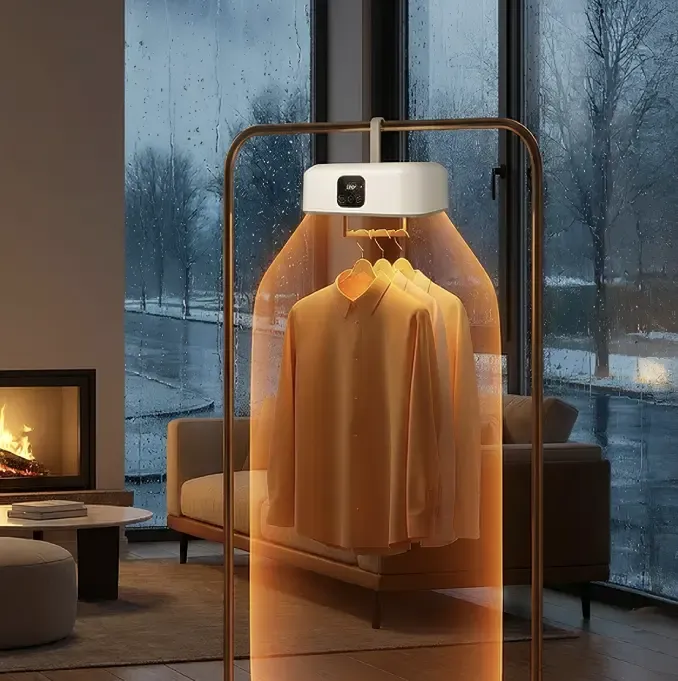
Look at the map again and you will notice that most branches end in the same two words: hang it. Hanging is gentle, keeps shapes and cuts wrinkles; its only weakness is speed. That is exactly the gap a hanging portable dryer such as the Qinux AirdrobeX fills: clothes hang still on hangers, a closed cover keeps warm air moving around every piece, and the timer switches it off by itself. Shirts, gym wear, baby clothes and delicates go in as they are; jeans and towels get their own cycle. Knits labeled dry flat should still be laid flat, as the label says.
Our recommendation: Qinux AirdrobeX
If your decision map keeps landing on “hang it, but I need it faster,” the Qinux AirdrobeX is the solution we recommend. It turns the slowest part of laundry day into a set-and-forget routine, without a vent, without installation and without tumbling your clothes.
- 360° warm-air circulation — dries every hanging garment on both sides at once.
- Gentle on fabrics — nothing tumbles, so cotton, polyester, wool blends and delicates keep their shape.
- Antibacterial UV light — according to the maker, helps eliminate bacteria, dust mites and odors.
- Touch panel, remote and programmable timer — set it and it switches off on its own.
- 600W from a regular outlet — low energy use, perfect for apartments and rainy weeks.
- Compact — stands in a corner while it works and folds away afterwards.
Owners rate it 4.8/5 from 1,289 reviews on the official site, and 94% would recommend it. One unit is $109 at the 50% launch discount, and multi-packs bring it down to $72 per unit, with free shipping and a 14-day money-back guarantee. It is sold only through the official website.
Want the full picture first? Read our AirdrobeX review, see the packages on the AirdrobeX home page or learn the setup in how to use a portable clothes dryer. Always follow the care label on each garment and the manufacturer’s manual.
Frequently asked questions
How do I know if something can go in the dryer?
Check the care label first. A square with a circle inside means tumble drying is allowed (dots show the heat level), and the same symbol crossed out means do not tumble dry. A square with a curved line means line dry, three vertical lines means drip dry and a horizontal line means dry flat. If there is no label, treat the item as delicate and dry it without tumbling.
What clothes should never go in a tumble dryer?
Anything labeled "do not tumble dry", plus most wool and cashmere knits, lingerie and bras with underwire, swimwear, items with rubber or foam backing and clothes with heavy embellishments. These do better hanging still or laid flat, which is also how a hanging portable dryer treats them.
Is it better to air dry or machine dry jeans?
Both work. Many people prefer air drying or low heat because high heat can shrink and fade denim. A good compromise is to turn jeans inside out, hang them by the waistband and give them their own load so they do not slow down lighter clothes.
Why do towels feel stiff when air dried?
Still air lets the cotton loops dry flat and set stiff. A good shake before hanging, less detergent and moving warm air all help towels come out softer. Towels also take the longest to dry, so give them their own load.
What is the fastest way to dry clothes without a tumble dryer?
Spin them well in the washer, hang each item on its own hanger with space between them, and surround them with moving warm air. A hanging portable dryer like the Qinux AirdrobeX does exactly that in a closed cover, so light loads dry much faster than on an open rack.