
The quick answer
Clothes take about 45–60 minutes in a tumble dryer, about 2–4 hours on a line outside on a warm, breezy day, and anywhere from 4 hours to a full day on a rack indoors. The place you dry in matters more than any trick: warmth, moving air and dry air make the clock run fast, while cold, still, humid rooms make it crawl. A warm-air portable dryer brings those three conditions indoors, which is why it lands in the middle of the table below.
“How long does it take to dry clothes?” sounds like a question with one number for an answer. In practice, the same load of laundry can be dry before lunch or still damp the next morning, depending on where it hangs. Below we compare the six places most people dry clothes, with realistic time ranges, what speeds each one up or slows it down, and how to choose the right method for your home and your week. All times are typical ranges for a normal load after a regular spin; your own results will vary with the fabric, the weather and your machine.
Drying times by place: the comparison table
| Where you dry | Light clothes (shirts, tees) | Heavy items (jeans, towels, hoodies) | What drives the time |
|---|---|---|---|
| Full-size tumble dryer | about 40–50 min | about 60–80 min | Load size, lint screen, vent airflow |
| Outside, warm and breezy day | about 2–4 hours | about 4–6 hours | Sun, wind, low humidity |
| Outside, cool or damp day | about 5–8 hours | most of the day or longer | Humidity, cloud cover, still air |
| Indoors, heated living room | about 4–8 hours | about 12–24 hours | Room temperature, airflow, spacing |
| Bathroom or basement | about 8–12 hours | often 24 hours or more | High humidity, small space, cool air |
| Warm-air portable dryer | a few hours on the timer | a longer cycle; thick items may need a second run | Warm air circulating around hanging clothes |
The ranges come from everyday laundry experience and common guidance from laundry and home publications; they are not lab measurements. Use them to plan, then fine-tune with your own loads. Our simple laundry log helps you learn your real numbers in two weeks.
1. In a tumble dryer: fastest, if you have one
A full-size dryer combines strong heat with a spinning drum and a vent that pushes moist air outside, so it wins on speed. A normal mixed load usually takes around 45–60 minutes. When a cycle starts taking much longer, the cause is almost always airflow: a full lint screen, a crushed vent hose or an overloaded drum. Our guide to a dryer that is hot but not drying walks through the checks.
What changes the choice: renters without hookups, small apartments and anyone trying to protect knits and delicates often cannot or would rather not tumble everything. Running cost also matters: full-size electric dryers draw several thousand watts while they heat, which we break down in how much electricity a clothes dryer uses.
2. Outside on a line: fast in summer, slow in November
Sun, a breeze and dry air are the perfect drying conditions, which is why a summer clothesline can beat a rack indoors by many hours. On a warm, breezy day, shirts can be dry in a couple of hours. The catch is that the weather decides. In late fall and winter, shorter days, damp air and cold temperatures stretch drying to most of the day, and rain sends everything back indoors anyway.
What changes the choice: outdoor drying depends on having a yard or balcony where it is allowed, on the season and on your schedule. If you leave for work at 8 and come back at 6, a line only helps on dry days.
3. Indoors in a heated room: the most common, and the most variable
This is where most people dry laundry from November to March, and it is also where drying times vary the most. Light shirts on hangers with space around them may be dry in an afternoon. Jeans and towels draped over a crowded rack can still feel cool and damp the next morning. Three things decide the clock: warmth, moving air and how humid the room already is. The EPA recommends keeping indoor humidity below 60%, ideally between 30% and 50%, to limit mold, and laundry drying in a closed room pushes that number up quickly.
Want to speed it up today? Spin at the highest speed the care label allows, hang clothes on hangers instead of folding them over a rail, leave a hand’s width between items, and keep air moving. Our list of 10 tips to dry clothes indoors fast covers each step, and why clothes take so long to dry indoors separates what you can change from what you cannot.
4. In the bathroom or basement: out of sight, slow to dry
Bathrooms and basements are popular because the laundry is out of the way. Unfortunately, they are also the slowest places to dry clothes. Bathrooms are small and fill with steam after every shower; basements are often cool and naturally damp. In both, the air is already close to saturated, so water leaves the fabric slowly, and slow drying is exactly what produces that sour, musty smell. If you must use these rooms, run the exhaust fan or a dehumidifier, keep the door open and never hang laundry right after a shower. When the smell has already set in, our guide on getting rid of the musty smell in clothes explains how to reset it.
5. With a warm-air portable dryer: the indoor shortcut
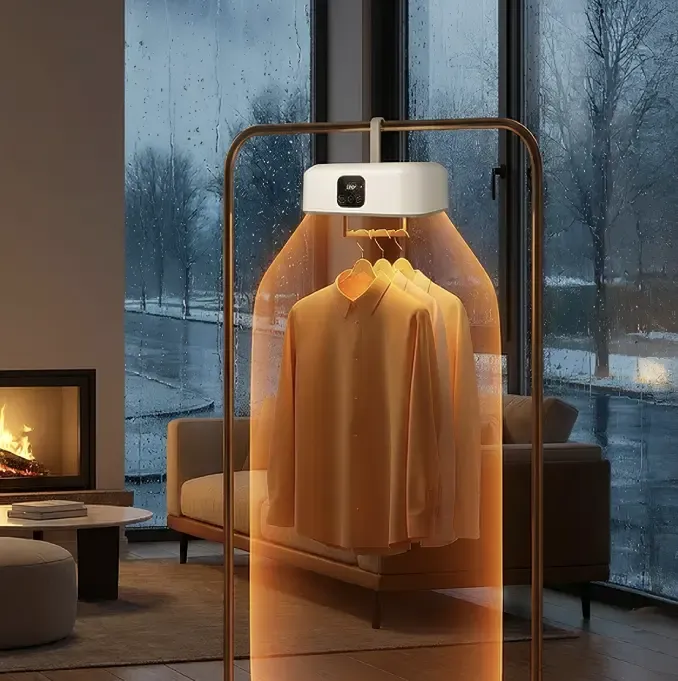
A warm-air drying closet brings the best of the clothesline indoors: warmth and moving air, right around the clothes, inside a cover that keeps the heat where it works. Instead of waiting for a whole room to warm up, the unit on top circulates warm air around each hanging garment. In our experience, that turns “dry by tomorrow” into “dry this evening” for everyday shirts, sweaters and light pants, with thick towels and jeans taking a longer cycle. The Qinux AirdrobeX works this way at 600W from a regular outlet, with a timer so you can set it and walk away.
What changes the clock in every place
- Spin speed — the wetter clothes leave the washer, the longer they take everywhere. A fast spin is the cheapest time-saver there is.
- Fabric — polyester and gym wear dry fastest; cotton is in the middle; denim, towels and wool hold the most water.
- Spacing — clothes touching each other dry like one thick item. Hangers with gaps dry faster than a packed rack.
- Air movement — still air around wet fabric stays humid; moving air carries the moisture away.
- Warmth and room humidity — warm, dry air absorbs water faster than cold, damp air.
How to choose the right method for your home
| Your situation | Best everyday choice | Why |
|---|---|---|
| House with a laundry room and dryer | Tumble dryer for towels and sturdy cotton, hangers for delicates | Fastest for big loads; gentler options for knits |
| Apartment without hookups | Warm-air portable dryer | Dries hanging clothes in hours from a regular outlet, no vent |
| Yard or balcony, mild climate | Line outside on dry days, indoor backup for rain | Free and fast in good weather |
| Small, humid home or winter months | Warm-air dryer plus ventilation | Keeps drying fast while limiting damp air |
Our recommendation: Qinux AirdrobeX
If you dry laundry indoors for even part of the year, the honest conclusion of the table above is simple: the long waits come from cold, still, humid air, and the fix is warm air moving around the clothes. That is exactly what the Qinux AirdrobeX was made for. You hang shirts, sweaters, jeans and towels on hangers inside its cover, set the timer, and 360° warm air circulates around every piece while a UV lamp runs alongside. It is the most practical way we know to turn a full day on a rack into an evening.
- 360° warm-air circulation — dries both sides of hanging clothes, seams and cuffs included.
- 600W from a regular outlet — about 9¢ an hour at 15¢ per kWh, with no vent or installation.
- Timer, touch panel and remote — it switches itself off when the cycle ends.
- UV light — according to the maker, it helps eliminate bacteria, dust mites and odors while clothes dry.
- Folds away — compact to store on days you do not need it.
One unit is $109 at the 50% launch discount (two units $190, three $240), with free shipping, a 4.8/5 rating from 1,289 buyers and a 14-day money-back guarantee. It is sold only through the official website. Read our full Qinux AirdrobeX review or see the packages on the home page.
For the bigger picture on types, running cost and safety, see our complete portable clothes dryer guide. Always follow the care label on each garment and the manufacturer’s instructions.
Frequently asked questions
How long does it take to dry clothes in a dryer?
A typical mixed load in a full-size tumble dryer takes roughly 45 to 60 minutes on a normal cycle, and towels or jeans can take longer. Overloading, a clogged lint screen or a blocked vent can stretch it well past an hour.
How long does it take to air dry clothes indoors?
On a rack in a heated room, light shirts often dry in about 4 to 8 hours, while jeans, hoodies and towels can take 12 to 24 hours or more. In a cold or humid room, add several hours. Moving air and a fast spin cut the time the most.
How long does it take clothes to dry outside?
On a warm, breezy, sunny day, light clothes can be dry in 2 to 4 hours on a line. In cool, damp or still weather, the same load may need most of the day, and in freezing weather it can take far longer.
Why do my clothes take longer to dry in the bathroom?
Bathrooms are small and humid, especially after showers, so the air is already full of moisture and evaporation slows down. Run the exhaust fan, keep the door open and avoid drying right after someone showers.
What is the fastest way to dry clothes without a tumble dryer?
Spin at the highest speed the care label allows, hang clothes with space between them and surround them with warm, moving air. A warm-air drying closet such as the Qinux AirdrobeX does the last part for you from a regular outlet, so hanging clothes dry far faster than on a rack in still air.
Does the type of fabric change drying time?
Yes, a lot. Thin polyester and athletic wear dry fastest, cotton shirts are in the middle, and thick cotton towels, denim and wool hold the most water and take the longest wherever you dry them.