
The quick answer
Keep a tiny laundry log for two or three weeks: for every load, note the fabric, the spin speed, how many items, the timer setting and whether everything came out dry. Then multiply the appliance wattage by the hours it ran to see the energy each load used. After a dozen loads you will know the right timer setting for each type of laundry and roughly what drying costs you, instead of guessing every time.
Most of us dry laundry on autopilot. We pick a timer setting, hope for the best and find out an hour later that the jeans are still damp at the waistband. Then we add time, forget about it, and the next week we guess again. A laundry log breaks that loop. It is not a chore or a spreadsheet project: it is a few words per load that, after a couple of weeks, tell you exactly how your clothes, your machine and your home behave together.
Why a laundry log beats guessing
Drying time is decided by a handful of variables: how much water is left in the fabric after the spin, how thick the fabric is, how much air moves around each item, and how warm and humid the room is. You cannot see any of that by looking at a basket of wet clothes. You can, however, see the result, load after load. Writing it down gives you three things:
- A reliable timer setting per load type — no more extra cycles “just in case”.
- A clear picture of your energy use — based on your own appliance and your own bill, not on a generic estimate.
- Early warning for problems — if the same load suddenly takes longer, something changed: a weaker spin, a packed cover or a damp room.
The free laundry log template
Copy this into a notebook, a notes app or a simple spreadsheet. One row per load is enough.
| Date | Load (fabric & items) | Spin | Timer set | Result | Room / notes |
|---|---|---|---|---|---|
| Mon | 8 cotton T-shirts | High | Your setting | All dry | Window ajar |
| Wed | 2 jeans, 1 hoodie | High | Your setting | Waistbands damp | Rainy day |
| Fri | Gym wear, leggings | Medium | Your setting | All dry early | — |
| Sun | 3 bath towels | High | Your setting | Dry, slightly stiff | Shake well next time |
The examples above only show what a row looks like. Fill in your own times: the maker of the Qinux AirdrobeX does not publish fixed drying times because they depend on the fabric and the spin, and your log is the best way to learn them.
What to write down (and what to skip)
Keep the log short, or you will stop using it. These are the details that actually explain drying time:
- The load typeGroup items the way you dry them: light everyday, synthetics and gym wear, heavy (jeans, hoodies, towels), delicates. Our if-then guide for every item in your laundry basket helps you sort.
- How many itemsA rough count is enough. Crowding is the most common reason one load takes longer than the last.
- Spin speedThe washer removes water faster than any dryer. A higher spin, where the care label allows it, often shows up in your log as a shorter drying time.
- The timer settingWrite the exact setting you chose, so you can repeat it or adjust it next time.
- The result“All dry”, “collars damp”, “dry early”. Three words are enough.
- Room conditionsRainy day, heating on, window closed. Humid, still air slows drying, and this column explains most surprises.
Skip anything you will not act on, like exact temperatures or weights. If you cannot change it, you do not need to track it.
How to work out the energy cost of each load
You do not need a smart plug or a special meter for a good estimate. You need three numbers: the appliance wattage (on the label or in the manual), how long it ran (your log) and the price per kilowatt-hour on your electricity bill.
| Step | Formula | Example with a 600W appliance |
|---|---|---|
| 1. Energy used | Watts × hours ÷ 1,000 = kWh | 600 × 1 ÷ 1,000 = 0.6 kWh per hour of use |
| 2. Cost per load | kWh × your price per kWh | 0.6 kWh × the rate printed on your bill |
| 3. Cost per month | Cost per load × loads per month | Add up the rows in your log |
If you also want to compare with a full-size machine, our guide on how much electricity a clothes dryer uses explains where to find the wattage of a tumble dryer and how the numbers stack up. Some people also like to note their monthly kWh from the bill before and after changing how they dry laundry; it is a simple way to see the effect in your own home.
Reading your log: patterns to look for
After two or three weeks, sit down for five minutes and read the log from top to bottom. These are the patterns most people find:
- Heavy items always come out damp at the seams → give jeans and towels their own load and a longer setting, and turn them inside out.
- Rainy or cold days take longer → that is the room, not the appliance. Crack a window or run the load in a room with better airflow.
- Big loads are slower than two small loads combined → split them. Space around each item matters more than the size of the load.
- The same load suddenly takes longer → check the washer spin and how full the cover is. Our list of portable clothes dryer mistakes covers the usual causes.
Once the patterns are clear, write a short “cheat line” at the top of your log, one setting per load type, and you can stop logging every load. Check in again when the seasons change, because indoor humidity changes too. Your log also shows which hours work best for you; our guide to the best time to do laundry adds off-peak pricing and drying to the picture.
Where a portable dryer makes the log easy
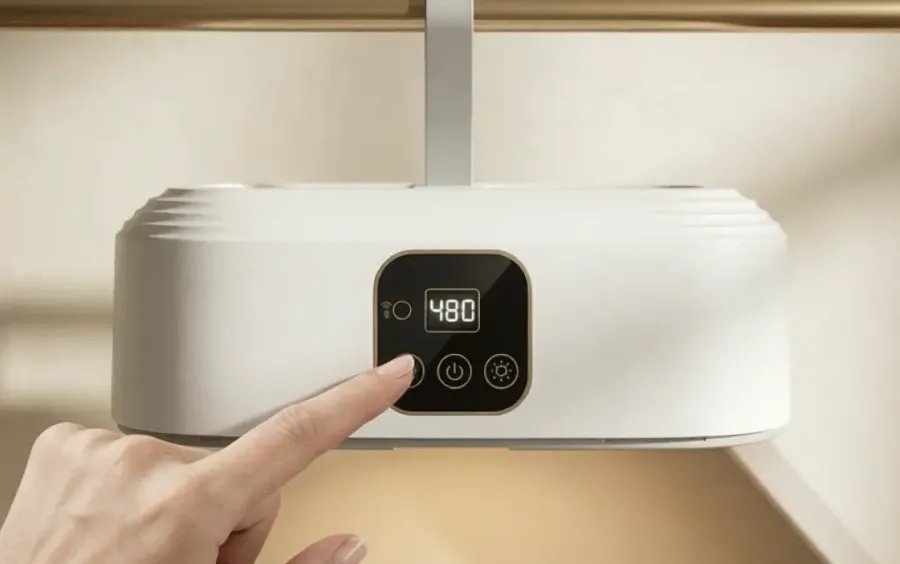
A log works with any drying method, but it is easiest with an appliance that has a real timer and runs the same way every time. With the Qinux AirdrobeX, clothes hang on hangers inside a closed cover, warm air circulates 360° around them, and the programmable timer switches the unit off on its own. That means the “timer set” column in your log is exact, the 600W rating makes the energy math simple, and the results repeat from week to week, so your cheat line actually holds.
Our recommendation: Qinux AirdrobeX
If your log shows that drying laundry is the slow, unpredictable part of your week, the Qinux AirdrobeX is the solution we recommend. It is made for exactly the households that keep a laundry log in the first place: apartments without a tumble dryer, rainy weeks, and anyone who wants to know what drying actually costs.
- 600W from a regular outlet — low power, easy energy math and no vent or installation.
- Programmable timer, touch panel and remote — the setting you note in your log is the setting you get.
- 360° warm-air circulation — dries both sides of every hanging garment at once.
- Antibacterial UV light — according to the maker, helps eliminate bacteria, dust mites and odors.
- Gentle on fabrics — nothing tumbles, so cotton, wool, polyester and delicates keep their shape.
- Compact — stands in a corner while it works and folds away afterwards.
Owners rate it 4.8/5 from 1,289 reviews on the official site, and 94% would recommend it. One unit is $109 at the 50% launch discount, and multi-packs bring it down to $72 per unit, with free shipping and a 14-day money-back guarantee. It is sold only through the official website.
Want the details first? Read our full AirdrobeX review, see the packages on the AirdrobeX home page or start with how to use a portable clothes dryer. Always follow the manufacturer’s manual and the care label on each garment.
Frequently asked questions
How long does it take to dry clothes indoors?
There is no single number. It depends on the fabric, how well the washer spun the load, how full the rack or cover is, and how warm, humid and airy the room is. On an open rack in still, humid air a load can take a day or more; with moving warm air it is much faster. A simple log of your own loads gives you the real answer for your home.
How do I calculate how much electricity my dryer uses per load?
Multiply the appliance wattage by the hours it runs and divide by 1,000 to get kilowatt-hours (kWh), then multiply by the price per kWh shown on your electricity bill. For example, a 600W appliance running for one hour uses 0.6 kWh; at your own rate you can work out the exact cost.
What should I write down in a laundry log?
Date, what was in the load (fabric type), spin speed, how many items, the timer setting, whether everything was dry at the end, and anything unusual such as a rainy day or a cold room. Those few columns are enough to spot patterns after two or three weeks.
How often should I review my laundry log?
Glance at it after each load and do a short review once a week. After about two or three weeks you will usually see clear patterns, such as which fabrics need extra time and which timer setting works for your everyday loads.
Does a portable clothes dryer use less energy than a tumble dryer?
Wattage gives you a fair first comparison: many full-size electric tumble dryers are rated in the thousands of watts, while the Qinux AirdrobeX is rated at 600W. Your log, with your own times and your own electricity rate, shows the real difference in your home.